What Is UHMWPE? The Material Behind Stab-Resistant Clothing
UHMWPE stands for ultra-high-molecular-weight polyethylene: a thermoplastic made of extremely long polyethylene chains, which gives it unusual toughness, abrasion resistance and impact strength for a plastic this light. It is used in hip and knee replacements, industrial liners, ropes and high-strength fibres, and it is one of the main materials in modern protective clothing. The catch for anyone buying a jacket is that the name alone proves very little. The form of the material, how it is built into a garment and how that garment was tested matter just as much.
TL;DR
- UHMWPE is polyethylene with a molecular weight of millions of grams per mole, so its chains are far longer than in everyday plastics. That is where the toughness comes from.
- It is very light, absorbs almost no water, has low friction and wears extremely well. It is used in joint implants, industry, ropes and protective gear.
- Solid UHMWPE stock and high-strength UHMWPE fibre are related but different products. Protection depends on fibre, construction, layering and the exact test.
- “Contains UHMWPE” is not a safety claim. Ask for the tested garment, the standard, the laboratory and the threat it was tested against.
- UHMWPE is heat-sensitive, so care labels matter.
Table of Contents
- What UHMWPE actually means
- Why long chains make it so tough
- The main properties at a glance
- UHMWPE versus HDPE
- How UHMWPE is made into products
- Where UHMWPE is used
- Is UHMWPE cut resistant?
- Is UHMWPE bulletproof?
- What to ask before you buy a UHMWPE garment
- Heat, washing and care
- Our perspective: why we chose UHMWPE
- Our UHMWPE jacket
- FAQ
- Sources
What UHMWPE actually means
Polyethylene is the most common plastic in the world. Carrier bags, bottles and pipes are all polyethylene. What changes between them is the length of the molecular chains. Ordinary grades have chains of thousands of repeating units. UHMWPE has chains so long that the material behaves very differently.
There is no single universal threshold. ISO 21304-1:2019 identifies PE-UHMW materials by a very low melt flow rate (below 0.1 g/10 min at 190°C under a 21.6 kg load). It also notes that other standards define the class by molecular weight: ISO 11542 uses at least 1 million g/mol, and ASTM uses more than 3.1 million g/mol. The IEEE Technology Navigator describes typical molecular weights of between 3.5 and 10 million g/mol.
You will see the same material called UHMW, HMPE or HPPE. When people ask for the UHMWPE meaning, the short answer is: a polyethylene whose molecular chains are about as long as plastics get.
Why long chains make it so tough
The usual picture of a strong material is a rigid one. UHMWPE is not rigid in that sense. Its strength comes from its structure.
An orthopaedic materials review explains that the chains are so long and entangled that the entanglements act like physical crosslinks. Tie molecules also connect the crystalline regions. The result is a polymer that resists wear and absorbs impact, rather than simply being hard. UHMWPE is semi-crystalline, and the same review reports typical crystallinity of roughly 50 to 55% for the stock used in joint replacement.

This is why “strong” is the wrong single word for it. It is tough, slippery, abrasion-resistant and light all at once, and those are different properties.
The main properties at a glance
Exact numbers vary by grade, fibre orientation, processing and test method, so treat supplier figures as examples rather than constants.
| Property | Typical picture | Example source |
|---|---|---|
| Density | Very low, around 0.93 to 0.94 g/cm³, so it is lighter than water | Goodfellow, Plastim PE1000 data sheet |
| Water absorption | Negligible: 0.01% over 24 hours for Goodfellow’s fibre | Goodfellow |
| Friction | Low, with a coefficient of 0.1 to 0.2 in Goodfellow’s data | Goodfellow |
| Wear and impact | Outstanding abrasion and impact resistance | Celanese |
| Melting | Around 130°C for a solid PE1000 grade | Plastim data sheet |
A density below water’s is why UHMWPE feels almost weightless in a garment layer. Low water uptake is also useful in clothing, where a lining should not soak up rain or sweat and become heavy.
UHMWPE versus HDPE
HDPE (high-density polyethylene) is the plastic of milk bottles, pipes and toys. People often ask whether UHMWPE is simply a stronger version. It is more subtle than that.
A 2018 Los Alamos National Laboratory study measured more than 75% crystallinity in its HDPE samples against 50 to 60% in its UHMWPE samples. Peak melting temperatures were similar, at roughly 135 to 139°C. So HDPE can actually be the more crystalline of the two. What UHMWPE has is chain length and entanglement, which changes toughness and wear behaviour.

The practical trade-off is processing. HDPE is easy to mould and cheap. UHMWPE is chosen where wear, impact and low friction justify a harder manufacturing route.
How UHMWPE is made into products
The melt viscosity of UHMWPE is extremely high, so it does not flow through ordinary injection moulding. Celanese, a UHMWPE resin producer, lists it as a material for demanding applications, and manufacturers commonly use compression moulding or ram extrusion, then machine the stock. That difficulty is one reason finished UHMWPE products can cost more than ordinary polyethylene ones.
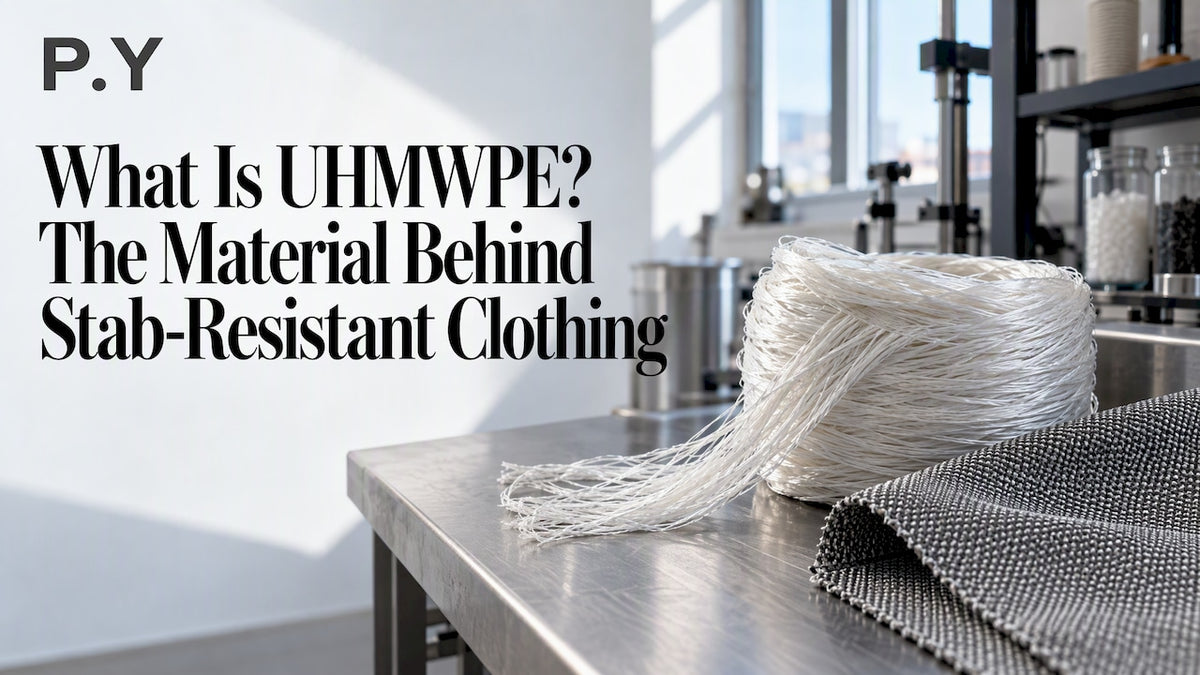
There is a second route. Gel-spun UHMWPE fibres are highly oriented, and technical reviews describe them as used in ballistic and other high-strength applications (ScienceDirect overview). Those fibres are woven, knitted or laid into laminates.
This matters for the next section. A machined block of UHMWPE and a layered fibre fabric are related, but they are not interchangeable products.
Where UHMWPE is used
- Joint replacement. It is the most common bearing material in total joint arthroplasty, and the medical literature records its use in this field since 1962.
- Industrial wear parts. Liners, rollers, guides and chutes, where its abrasion resistance and low friction extend service life.
- Ropes and lines. Light, strong fibre that does not take up water.
- Composites and ballistic laminates. Layered fibre sheets used in protective equipment.
- Protective clothing and gloves. Fibre used in cut-resistant textiles and in stab-resistant linings.
Is UHMWPE cut resistant?
Often, yes, particularly as a high-strength fibre. But the honest answer depends on how it is built.
In a peer-reviewed study of weft-knitted structures, a UHMWPE moss-tuck fabric reached EN 388 cut level 5 and conical-puncture level 4. Yet knife-puncture performance was highest for a para-aramid crepe structure in the same experiment. The researchers’ results show that stitch structure and yarn arrangement change the outcome a great deal. The same yarn can perform differently in different constructions.
Two lessons follow. First, UHMWPE is a very good candidate for cut protection. Second, an EN 388 cut level on a textile is not proof that a garment stops every knife attack. Cutting (slashing), puncturing by a blade and stabbing with a spike are separate threats.
Is UHMWPE bulletproof?
UHMWPE fibre is used in ballistic protection, but the polymer is not automatically “bulletproof”. Protection depends on fibre grade, orientation, areal density, laminate design, backing, the projectile and certification, as Goodfellow’s technical notes make clear. A bulletproof claim has to be tied to a recognised ballistic test, not to the material name.
The same applies to stab resistance. A fibre marketed as ballistic-grade does not by itself prove resistance to a particular knife, spike or strike energy.
What to ask before you buy a UHMWPE garment
If you are comparing protective clothing, the useful question is not “does it contain UHMWPE?” but “what hazard and standard was the complete garment tested against?” Use this checklist:
- Which model was tested? The report should refer to the garment or the exact panel construction you are buying, not a similar one.
- Which independent laboratory carried out the test? Third-party testing is stronger than a manufacturer’s own statement.
- Which standard and level? Look for a named standard, a protection level and the test conditions, including strike energy.
- What is the threat? Slash, puncture, spike and ballistic are different. Check which one the claim covers.
- What is the coverage? A protective layer over the torso does not protect arms, neck or lower body.
- What are the care instructions? See the next section.
Generic wording such as “cut-proof” or “bulletproof” with no report behind it should make you cautious. If a seller cannot answer the questions above, move on.
Heat, washing and care
A practical surprise: UHMWPE is heat-sensitive. ScienceDirect’s overview reports that the fibres melt at roughly 144 to 152°C, are generally not intended for prolonged exposure above about 80 to 100°C, and that published testing found substantial strength loss after dry heating at 140°C for one hour.
For a jacket this means:
- Do not iron the protective lining or put it in a tumble dryer unless the care label explicitly allows it.
- Avoid leaving a protective garment on a hot car parcel shelf or in a boot on a summer day.
- Follow the maker’s care instructions rather than general laundry habits.
Our perspective: why we chose UHMWPE
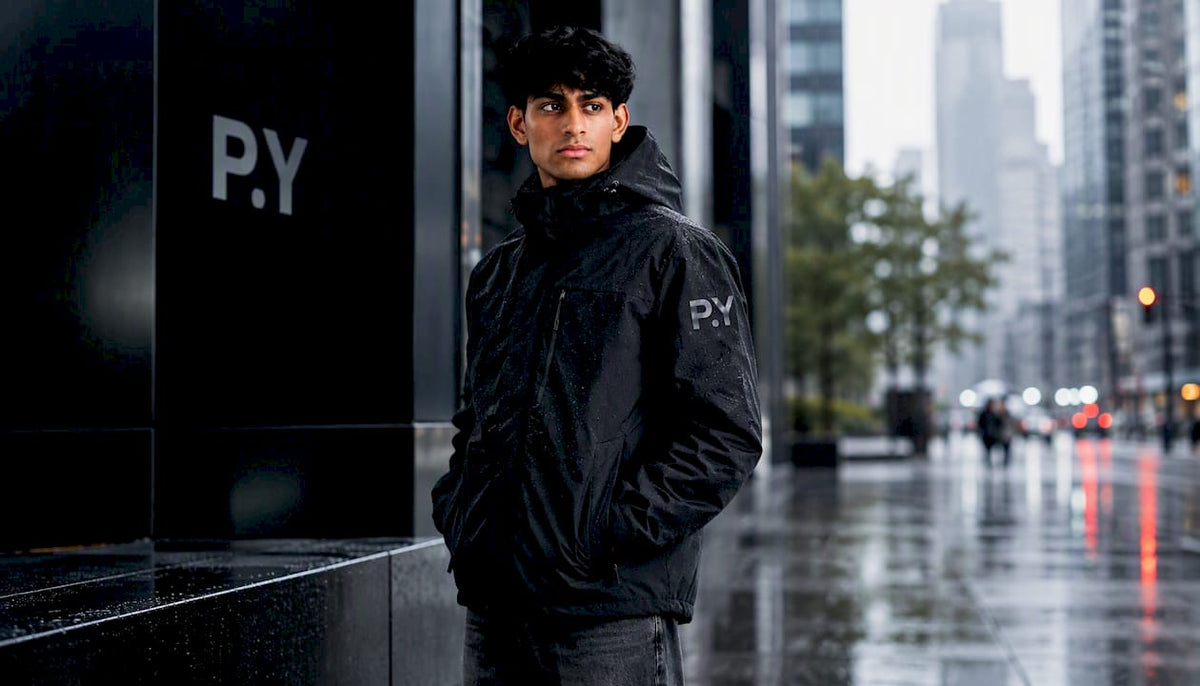
We built our jackets around UHMWPE protective inner linings because we wanted protection that does not look like protection. The material is light and holds very little water, so it can sit inside a jacket without turning it into body armour. Our outer shells are water-resistant, with adjustable hoods and secure zip pockets, so the jacket works as everyday streetwear first.
But we are the first to say that the name of a material is not a guarantee. That is why our jackets are independently tested to EU standards, and why we would encourage you to ask any seller, us included, for the test evidence. You can see how we describe our materials and testing on our jacket material and testing page. Parents buying for teenagers have extra questions, which we cover in our guide to buying stab-proof gear for teens.
Protective clothing reduces risk in certain situations. It does not make anyone invincible, and it is no substitute for avoiding danger.
— Guy
Our UHMWPE jacket
Our current product line, 001, is a stab-resistant streetwear jacket with a UHMWPE protective inner lining, a water-resistant premium outer shell, an adjustable hood and secure zip pockets. It is made to be worn every day and to stay discreet. It costs £275 (one-off payment). You can see it on the 001 product page or browse the full collection.

FAQ
What does UHMWPE stand for?
It stands for ultra-high-molecular-weight polyethylene. It is a thermoplastic with extremely long molecular chains, which gives it high toughness, abrasion resistance and impact resistance. You will also see it written as UHMW, HMPE or HPPE.
Is UHMWPE stronger than HDPE?
It is tougher and more wear-resistant, but not in every respect. The Los Alamos study found HDPE samples were more crystalline, while UHMWPE’s long-chain entanglement gives it different toughness. HDPE is far easier and cheaper to process, which is why it is used in bottles and pipes.
Is UHMWPE stab proof?
Not by name alone. Stab resistance depends on the fibre, how the fabric or laminate is constructed, the number of layers and the specific test standard. Ask for the test report for the exact garment, including the laboratory, the standard and the strike conditions.
Can you wash or iron UHMWPE clothing?
Check the care label first. UHMWPE fibres are generally not meant for prolonged exposure above about 80 to 100°C, and tests show strength loss after heating at 140°C, so ironing and hot tumble-drying are risky. Follow the maker’s instructions.
Sources
- ISO 21304-1:2019, PE-UHMW designation system
- IEEE Technology Navigator: UHMWPE
- UHMWPE wear behaviour review (PMC)
- Goodfellow UHMWPE fibre data
- Plastim PE1000 technical data sheet
- Los Alamos thermal characterisation of HDPE and UHMWPE
- Celanese GUR UHMW-PE
- Weft knitted structures for cut and puncture protection
- ScienceDirect Topics: UHMWPE overview